Consulting and Advisory
Independent expertise to keep you compliant and future-ready.
Our Consulting and Advisory service equips you with the expert insight and independent guidance you need to stay ahead of regulatory change, close critical compliance gaps and map your team’s skills and capability to identify strengths, risks and training priorities.
From individual Responsible Manager assessments, AFSL skills mapping to AML/CTF training program reviews and executive briefings, we deliver actionable insights that fuel targeted learning and drive measurable performance uplift.
As an ASIC Authorised Assessor, we also benchmark staff programs against ASIC’s Australian Financial Services License (AFSL) conditions to keep your people, processes, and compliance at the highest standard.
Contact us to discuss potential opportunities and gain further insights about our Customised Corporate Solutions.

We offer:

Training Gap Analysis
Gap analysis of existing training against ASIC RG 105, RG 146 and industry codes.
Individual Assessments
Individual assessments for Responsible Managers (RG 105 Option 2) and RG 146 knowledge requirements.
Capability Mapping
Compliance program design, competency reviews, skills and capability mapping to internal training programs
For the Board
Board and senior-management briefings on emerging regulatory trends.
What others say about us
Industry leaders in CPD
The delivery method, the flexibility and the currency and relevance of content. FEP are and have always been a leader in CPD for the
finance industry – thankyou
Parallels real workplace experience.
We have been using FEP for a number of years now. The course materials are highly professional and parallels real workplace experience. Staff greatly value participating in meaningful external training and are the greatest advocates.
Efficient, informative and accessible.
The content is well set out, clear and precise. My organisation does the course every year and we are continuing to learn new and interesting things with each new offering. The content is up to date with the industry and completely relevant to my role. I had all the support and learning resources available to get it done…
Extremely relevant and meaningful.
Our firm exclusively uses the services of Financial Education Professionals for all of our ongoing RG146, compliance and responsible manager training for our team. We find course materials extremely relevant and meaningful and this allows our team to have up to date, practical knowledge.
Regulatory News
-
27 March 2026
ASIC invites feedback on proposed derivative transaction reporting rules updates
27 March 2026ASIC is consulting industry and interested stakeholders on proposed updates to the ASIC Derivative Transaction Rules (Reporting) 2024 (the 2024 Rules).
The proposed changes aim to simplify reporting and reduce regulatory complexity, in response to industry feedback.
The updates would also help align Australia’s framework with international standards, while improving the quality of the data reported to ASIC.
The 2024 Rules set out the requirements for reporting derivative transaction information to derivative trade repositories.
A copy of the proposed updates to the 2024 Rules, along with a detailed summary of the changes, is available on the consultation webpage.
Providing feedback
ASIC welcomes feedback on the proposed changes from industry and interested stakeholders.
Submissions should be sent to otcd@asic.gov.au by 5pm (AEST) on 8 May 2026.
Further information, including how to make a submission, is available on the consultation webpage.
View ASIC WebsiteASIC invites feedback on proposed derivative transaction reporting rules updates
ASIC is consulting industry and interested stakeholders on proposed updates... -
27 March 2026
Direct to APRA security update and accelerated decommission
27 March 2026The Australian Prudential Regulation Authority (APRA) has decommissioned its legacy Direct to APRA (D2A) data submission system for entity access. The system was taken offline on Friday 20 March following the identification of security vulnerabilities through a routine penetration test on Thursday 19 March.
APRA is accelerating its program to transition all APRA’s data collections onto the singular interface of APRA Connect.
This action is precautionary and in line with APRA’s low risk tolerance for system vulnerabilities that may expose APRA or regulated entities to attack. APRA is not aware of any security breaches or exploitation on APRA’s systems.
View APRA WebsiteDirect to APRA security update and accelerated decommission
The Australian Prudential Regulation Authority (APRA) has decommissioned its legacy... -
27 March 2026
Payday Super Readiness
27 March 2026The Australian Prudential Regulation Authority (APRA) and the Australian Taxation Office (ATO) have today issued a letter to RSE licensees regarding the commencement of Payday Super on 1 July 2026.
The letter sets out the ATO’s and APRA’s roles in the implementation of Payday Super, the relevant regulations and standards to support Payday Super, and next steps to support RSE licensee implementation readiness by 1 July 2026.
The letter is available at: Payday Super Readiness
View APRA WebsiteThe Australian Prudential Regulation Authority (APRA) and the Australian Taxation... -
27 March 2026
ASIC updates financial reporting relief instruments
27 March 2026ASIC has remade three legislative instruments that provide financial reporting relief following consultation with industry.
The new instruments, which replace instruments due to sunset on 1 April 2026, are:
- ASIC Corporations (Rounding in Financial/Directors’ Reports) Instrument 2026/183
- ASIC Corporations (Electronic Lodgment of Financial and Sustainability Reports) Instrument 2026/59, and
- ASIC Corporations (Disregarding Technical Relief) Instrument 2026/180.
These instruments will expire on 1 April 2031.
ASIC consulted on our proposal to:
- remake the three instruments
- withdraw Regulatory Guide 28 Relief from dual lodgment of financial reports (RG 28) because it provides redundant guidance, and
- repeal ASIC Corporations (Offer Information Statements) Instrument 2016/76 in CS 45 Proposed remake and sunset of financial reporting-related legislative instruments.
As a result, in addition to remaking the three instruments, ASIC will:
- withdraw RG 28
- repeal ASIC Instrument 2016/76 consistent with the proposal to allow the instrument to expire
- amend ASIC Corporations (Share and Interest Purchase Plans) Instrument 2019/547 to reflect the remade ASIC Instrument 2026/180, and
- make minor amendments to RG 125, RG 173, RG 189, RG 254 and INFO 31 in April 2026.
ASIC updates financial reporting relief instruments
ASIC has remade three legislative instruments that provide financial reporting... -
27 March 2026
Binance Australia Derivatives ordered to pay $10 million penalty for onboarding failures causing millions in client trading losses
27 March 2026The Federal Court has ordered Oztures Trading Pty Ltd (trading as Binance Australia Derivatives) (Binance) to pay a $10 million pecuniary penalty after misclassifying more than 85% of its Australian client base over a nine-month period, resulting in more than $12 million in losses and fees.
Binance is part of the Binance Group, the operator of the world’s largest digital crypto exchange by trading volume.
In a Statement of Agreed Facts, Binance admitted it exposed 524 retail investors to high-risk crypto derivative products without the required consumer protections between July 2022 to April 2023, due to their misclassification as wholesale clients.
Binance admitted to serious failures in client onboarding and poor staff training that allowed clients seeking to be verified as sophisticated investors to make unlimited attempts at a multiple-choice quiz until they achieved a passing score for Binance to assess them as qualifying for sophisticated investor status.
Additionally, Binance’s senior compliance staff provided inadequate oversight or review of client applications and supporting documentation, further weakening the onboarding and classification processes.
For example, Binance incorrectly assessed an individual as qualifying as a professional investor on the basis that the client certified that they were an ’exempt public authority’, without adequate verification.
This misclassified client group went on to incur $8.66 million in client trading losses and paid $3.89 million in fees.
In addition to the pecuniary penalty, Justice Moshinsky ordered Binance to contribute to ASIC’s costs.
The penalty comes in addition to approximately $13.1 million in compensation paid to the affected clients, which ASIC oversaw in 2023 (23-298MR).
View ASIC WebsiteThe Federal Court has ordered Oztures Trading Pty Ltd (trading... -
26 March 2026
Protecting our superannuation system is everyone’s responsibility
26 March 2026Commissioner Alan Kirkland delivered a speech to the Superannuation Lawyers Conference on 26 March 2026.
Here are the highlights of Alan’s speech:
- The scale of the Shield and First Guardian failures threaten to undermine trust in our superannuation system more broadly.
- ASIC’s actions in relation to these matters should signal that we view superannuation trustees as a significant link in the chain of conduct that led to these outcomes.
- Trustees are in a unique position to identify harmful switching practices in real time, as they control the systems through which rollovers, advice fee deductions, and investment choices occur.
Find out more here: Protecting our superannuation system is everyone’s responsibility
View ASIC WebsiteProtecting our superannuation system is everyone’s responsibility
Commissioner Alan Kirkland delivered a speech to the Superannuation Lawyers... -
26 March 2026
ASIC updates relief instrument for generic financial calculators
26 March 2026ASIC has remade a legislative instrument, which gives relief to providers of generic financial calculators from certain licensing requirements under the Corporations Act 2001 (Corporations Act).
ASIC Corporations (Generic Calculators) Instrument 2026/41 (ASIC Instrument 2026/41) continues relief provided under ASIC Corporations (Generic Calculators) Instrument 2016/207 (ASIC Instrument 2016/207) until 1 April 2031.
We have determined that the instrument is operating effectively and efficiently and continues to form a useful part of the legislative framework.
ASIC will also make minor amendments to RG 167 AFS licensing: Discretionary powers, RG 276: Superannuation forecasts: Calculators and retirement estimates and INFO 248: Enhanced regulatory sandbox in April 2026.
View ASIC WebsiteASIC updates relief instrument for generic financial calculators
ASIC has remade a legislative instrument, which gives relief to... -
25 March 2026
After Acacia: The Next Era of Financial System Innovation?
25 March 2026Brad Jones*
Assistant Governor (Financial System)Remarks at the Australian Payments Plus ‘Beyond Tomorrow’ Forum
Sydney –RBA Assistant Governor Brad Jones has hailed the opportunities to uplift the functioning of Australia’s wholesale markets through the tokenisation of assets and money, as identified through Project Acacia. Speaking at the Australian Payments Plus ‘Beyond Tomorrow’ Forum, Jones said financial innovation had allowed Australia to punch above its weight on the international stage in some key areas, tokenisation was likely to be an element of designing a financial system that was more dynamic and resilient to technological disruption, in Australia’s national interest.
View sourceAfter Acacia: The Next Era of Financial System Innovation?
Brad Jones* Assistant Governor (Financial System) Remarks at the Australian... -
25 March 2026
APRA stress test shows how the widening home insurance protection gap may impact Australia’s financial system resilience
25 March 2026The Australian Prudential Regulation Authority (APRA) has released its Insurance Climate Vulnerability Assessment (Insurance CVA), a prudential stress test exploring how a changing climate could affect home insurance affordability and the insurance protection gap1 over coming decades.
Affordable and widely held home insurance supports a resilient and productive economy by protecting households against large and unexpected financial losses, enabling them to recover quickly after shocks.
The Insurance CVA is not a forecast or prediction of future outcomes. Instead, APRA examined how home insurance coverage may fall under two severe but plausible global climate-related scenarios projected out to 2050: one with higher physical risks from weather-related events and one with greater economic impacts from transitioning to a lower emissions economy.
It found that, under both scenarios, climate-driven pressures on insurance premiums could significantly widen the nation’s insurance protection gap, thereby increasing financial risks to the system.
APRA estimates that around one in seven Australian houses are uninsured today. Under both stress scenarios this could rise to around one in four by 2050 – equivalent to an additional one million homes without adequate home insurance.
View APRA WebsiteThe Australian Prudential Regulation Authority (APRA) has released its Insurance... -
23 March 2026
Moneysmart publishes tips on using AI for financial issues
23 March 2026ASIC’s Moneysmart website has published guidance to help Australians using publicly available AI tools for information on financial issues.
The consumer guidance – published for the first time on Moneysmart – responds to the growing use of publicly available AI tools to answer money questions, alongside social media and other digital sources.
New research commissioned by Moneysmart shows that:
- nearly one in five Gen Z Australians (18%) are using AI platforms for financial information and guidance
- almost two thirds (64%) say they trust AI platforms for money advice, including one in six (16%) who say they completely trust them
- nearly two thirds (63%) of GenZ are confident in the accuracy of financial guidance from AI platforms.
In response to these findings, the new Moneysmart guidance explains that while publicly available, general-purpose AI tools can help with learning and research on general topics, they have important limitations that could lead to inaccurate or inappropriate suggestions.
It sets out examples of when AI may be helpful – such as summarising complex information or answering general money questions – and when it’s a good idea to seek further information from trusted sources or seek advice from a licensed adviser.
While AI can be used as a learning tool, it should always be checked against trusted, independent sources to verify claims before acting on any information it gives you. We always encourage consumers to research broadly and not to rely on one source (whether AI or otherwise) when making decisions about their finances.
View ASIC WebsiteMoneysmart publishes tips on using AI for financial issues
ASIC’s Moneysmart website has published guidance to help Australians using... -
20 March 2026
Federal Court declares Macquarie contravened the Corporations Act in relation to Shield Master Fund
20 March 2026The Federal Court has today made declarations that Macquarie Investment Management Limited (MIML) contravened the Corporations Act by failing to place the Shield Master Fund (Shield) on a watch list for heightened monitoring.
Based on a Statement of Agreed Facts and Admissions filed by the parties, His Honour Justice Wheelahan made declarations that MIML should have placed the Shield investment options on a watch list so that they could be subject to further monitoring, such as additional reporting, due diligence, performance monitoring or other follow-up action.
ASIC commenced proceedings against MIML after accepting a court enforceable undertaking that Macquarie pay over 3,000 affected members 100% of the amounts they invested in Shield, less any amounts withdrawn (25-215MR).
Approximately $321 million was paid to affected members in September last year.
View ASIC WebsiteFederal Court declares Macquarie contravened the Corporations Act in relation to Shield Master Fund
The Federal Court has today made declarations that Macquarie Investment... -
20 March 2026
Treasurer convenes financial regulators
20 March 2026The Treasurer has convened a special meeting of the Council of Financial Regulators to assess the economic and financial market implications of the Middle East conflict, with regulators reaffirming the strength and resilience of Australia’s financial system. Despite heightened global uncertainty and rising fuel price pressures, officials pointed to strong economic fundamentals and a well-capitalised banking sector. The government is coordinating closely with regulators on risk preparedness, while rolling out measures to support fuel supply and pricing oversight, including releasing up to 762 million litres from reserves, appointing a Fuel Supply Taskforce Coordinator, easing fuel standards, and strengthening ACCC enforcement powers. Authorities say ongoing domestic coordination and engagement with international partners, including New Zealand, will focus on maintaining fuel security, stabilising prices, and reinforcing supply chain resilience.
View Treasury WebsiteTreasurer convenes financial regulators
The Treasurer has convened a special meeting of the Council... -
18 March 2026
ASIC launches financial complaints data dashboard
18 March 2026Australians now have unprecedented access to consumer complaints data following the launch of ASIC’s new interactive dashboard.
The Internal Dispute Resolution (IDR) data dashboard enables users to compare the complaints reported by individual financial firms for the first time, including their handling of complaints associated with specific products like home loans, credit cards, life and general insurance, or financial advice.
ASIC Commissioner Alan Kirkland said the data dashboard would enhance transparency by providing valuable insights into complaints volumes and trends, giving greater visibility of consumer concerns and potential harm across the financial services industry.
‘Transparency is crucial to supporting a fair, strong, and efficient financial system. The launch of our new internal dispute resolution data dashboard marks a significant step in improving public scrutiny of the system,’ he said.
Other key features of the dashboard include:
- an overview of complaints volumes and trends over specified reporting periods
- categorised breakdowns of complaints by issue and complaint outcome
- complaints resolution times for individual financial firms, and
- information about monetary remedies paid.
ASIC launches financial complaints data dashboard
Australians now have unprecedented access to consumer complaints data following... -
17 March 2026
Consultation open on reforms to financial adviser education requirements
17 March 2026The Albanese Government is acting to expand the availability of high quality and safe financial advice for Australians.
We are starting consultation on the Government’s reforms to the education standards for financial advisers which will create a sustainable and flexible pathway for new advisers to enter the profession, to help address the decline in the number of advisers over recent years.
When consumers aren’t able to access quality, trusted financial advice, they are more susceptible to predatory forms of lead generation and high‑pressure sales tactics.
This policy complements the consultation paper on managed investment scheme reform released by the government in February, and our broader work on consumer protection in the superannuation sector which we will begin consulting on soon.
Alongside consumers, Australians seeking to work in financial services will benefit by streamlining entry into the industry, while retaining the important role of tertiary education.
The proposed standard will require prospective advisers to hold a bachelor’s degree or higher. They will also need to meet minimum study requirements in relevant areas such as finance, economics or accounting, along with completing mandatory financial advice subjects covering ethics, legal and regulatory obligations, consumer behaviour and financial advice fundamentals.
These reforms ensure continuing robust professional standards for advisers, including requirements for completing a professional year, passing the financial adviser exam and maintaining continuing professional development.
These reforms build on the Government’s Delivering Better Financial Outcomes package to help address the supply shortage of financial advisers and strengthen the industry’s ability to meet the future demand.
The Government is committed to delivering a comprehensive package of financial advice reforms that will increase Australians’ access to high‑quality, safe and affordable advice.
Consultation is available on the Treasury website and closes on 17 April 2026.
View Treasury WebsiteConsultation open on reforms to financial adviser education requirements
The Albanese Government is acting to expand the availability of... -
17 March 2026
APRA publishes Therese McCarthy Hockey’s remarks to the 2026 COBA CEO and Directors Forum
17 March 2026The road to resilience for mutual banks
Key points
View APRA Website- “A smaller number of mutuals isn’t indicative of a sector in decline. To the contrary, the mutual banking sector continues to deliver solid aggregate performance, with growth outpacing system trends across assets, deposits and housing lending. But if we peer beneath these rosy headline figures, we see a widening structural divide between the largest mutuals and a long tail of small banks, some of which have cost structures, growth capacity and operating models that appear increasingly challenged.”
- “Banks of all sizes also need to be thinking carefully about how they manage the risks associated with incorporating advanced AI into their businesses. We completely understand why the potential for reduced costs and improved productivity is appealing for smaller banks. The key concern for regulators is that industry usage is expanding faster than understanding of the long-term risks and impacts.”
- “While all banks are feeling the squeeze as they seek to mitigate new and growing risks, we’ve seen that banks with greater economies of scale are better able to make the necessary investments and absorb the fixed costs of digital transformation. APRA holds some concern, however, that without the necessary deep pockets, some of the smallest mutuals will eventually find their business models are no longer viable.”
- “The smaller mutuals that are performing most strongly have robust strategies that recognise the way banking is evolving and face into those issues; they have strong governance, including directors with the skills and experience needed for a modern banking environment; they also have effective cost management and sound risk management practices.”
APRA publishes Therese McCarthy Hockey’s remarks to the 2026 COBA CEO and Directors Forum
The road to resilience for mutual banks Key points “A... -
16 March 2026
ASIC urges Gen Z to ‘sense-check’ money advice as social media fuels riskier financial decisions
16 March 2026ASIC is urging young Australians to ‘sense check’ the information they see online, as new research shows nearly two thirds of Gen Zs are using social media and about one in five are using AI to make decisions about their financial future.
Moneysmart’s Gen Z study found that while Gen Z has a strong appetite for reputable and trustworthy financial content, many struggle to find it – and their search often leads them to sources designed for engagement rather than accuracy.
High levels of trust in often unreliable sources by some young Australians is contributing to riskier financial decisions such as investment in cryptocurrency based on limited or unproven information.
- 63% of Gen Z respondents (aged 18–28) said they use social media for financial information and guidance, while 30% use YouTube and 18% use AI platforms.
- More than half of Gen Z say they somewhat or completely trust financial information on social media (56%) and from ‘finfluencers’ (52%), while 64% say they trust AI platforms.
- Encouragingly, 60% also reported using formal or professional sources, and half (50%) turn to family and friends. But the survey highlights that social media remains a dominant influence, even when young people recognise its limitations.
ASIC urges Gen Z to ‘sense-check’ money advice as social media fuels riskier financial decisions
ASIC is urging young Australians to ‘sense check’ the information... -
16 March 2026
Moneysmart refresh puts young Australians at the centre of trusted financial guidance
16 March 2026ASIC has launched a refreshed Moneysmart website and user experience, marking 15 years since the consumer education platform began helping Australians to make better-informed financial decisions.
The refresh is designed to make Moneysmart more accessible, engaging and relevant for Australians of all generations and backgrounds navigating an increasingly complex online financial environment.
The refresh is designed to reflect how Australians – especially younger people – are learning about and making decisions with money today.
ASIC’s goal is to make Moneysmart easier to use and easier to understand at a time when good financial information has never been more important.
A modern update for Moneysmart
The refreshed Moneysmart features a new design, updated website content and fresh imagery that reflects consumers’ needs.
The website has been updated to ensure it is practical, easy to understand and relevant to real‑world financial decisions – from budgeting and saving to managing debt and understanding investment risks.
New research shows many young people are turning to social media for financial information, but not all of that information is reliable.
This refresh helps ensure Moneysmart provides a trusted alternative – free, independent and designed to help young Australians make decisions that work for them, not someone selling a product.
For trusted information and tools to help manage money and navigate financial decisions, visit moneysmart.gov.au.
View ASIC WebsiteMoneysmart refresh puts young Australians at the centre of trusted financial guidance
ASIC has launched a refreshed Moneysmart website and user experience,... -
16 March 2026
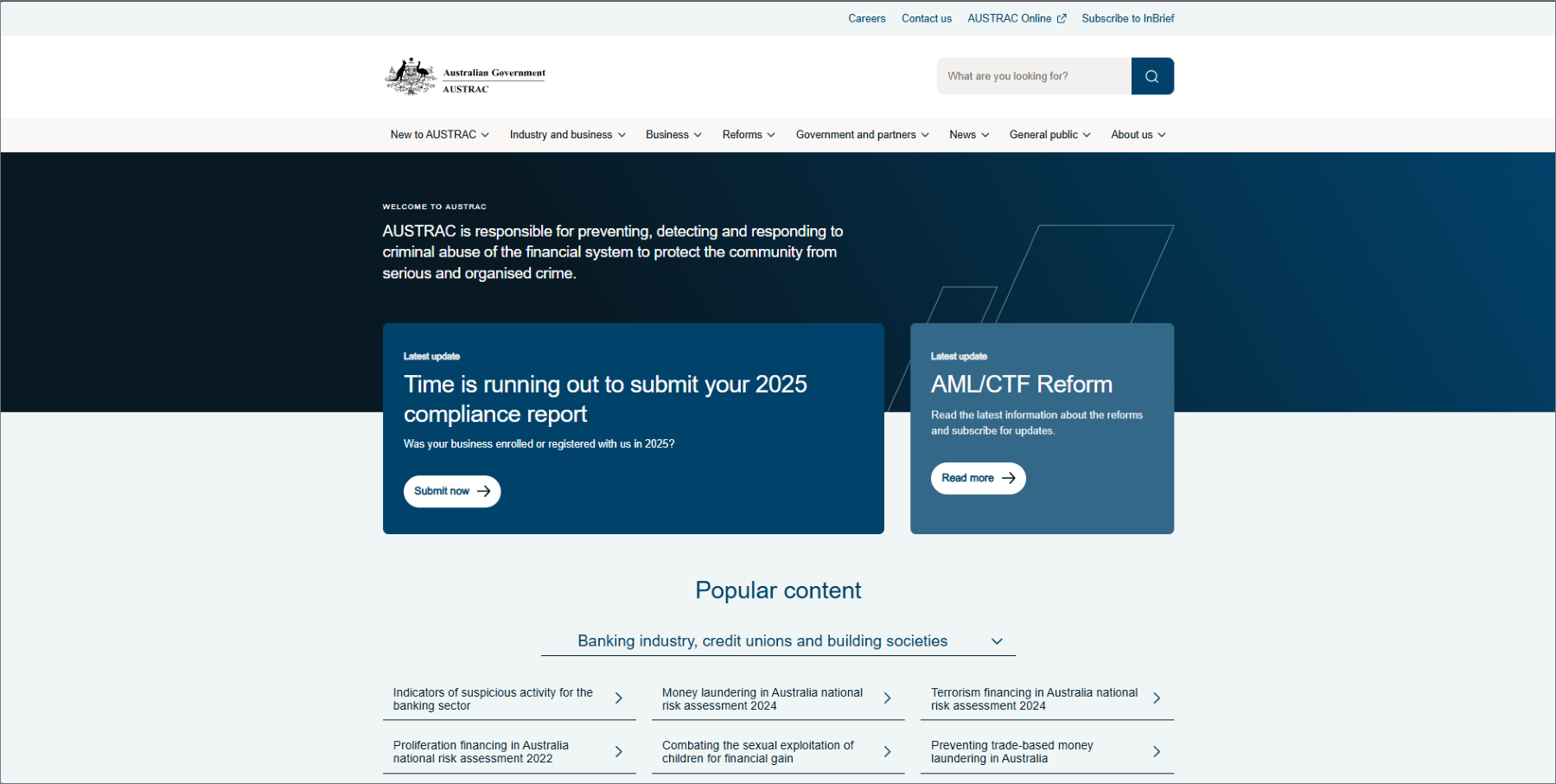
AUSTRAC’s website changes on the horizon
16 March 2026From 30 March, you’ll notice several improvements to our website, including:
- a refreshed look and feel to improve readability and usability
- a clearer menu structure, including improved pathways for users new to AUSTRAC, a more intuitive industry and business section and clearer separation of content areas
- improved search and filtering functionality to help you locate content more quickly
- an enhanced Contact Centre and support section to support self-service and access to help.
Below is a preview of the updated homepage and navigated structure.

View sourceAUSTRAC’s website changes on the horizon
From 30 March, you’ll notice several improvements to our website,... -
16 March 2026
APRA publishes John Lonsdale’s remarks to the 2026 AFR Banking Summit
16 March 2026Severe and here
Key points
View APRA Website- “Certain features of Australia’s geography, economy and financial system actually leave us vulnerable to global shocks: a banking system reliant on overseas markets for funding; a trade-exposed, open economy; a relatively small population by global standards; a concentrated banking industry that is uniquely exposed among comparable countries to residential mortgages; and a superannuation sector with billions of dollars of members’ savings invested overseas.”
- “At times of stress APRA more closely engages with banks, applying elevated scrutiny on their liquidity, credit and market risk. We also speak to banks to gain intelligence, as well as engaging closely with our counterparts on the Council of Financial Regulators. This is exactly what has been happening over the past fortnight. We are also reminding regulated entities to remain alert to non-financial risks including the potential for elevated cyber activity and impacts on operational resilience.”
- “Today I will be announcing plans to strengthen our framework with an uplift for the largest banks to bring their liquidity frameworks more in line with international practice. For smaller banks, we are proposing changes that should marginally reduce liquidity costs for entities with stable funding profiles. Mindful of Australia’s ongoing productivity challenges and our commitment to get the balance right, we are also proposing several measures to ease the regulatory burden for banks.”
- “Capital is the cornerstone of a bank’s financial resilience, but liquidity is just as important, especially in a crisis when banks may need to rapidly source funds to meet cash demand from deposit, debt and other cash outflows. Although Australia’s bank liquidity regime is adequate, our regime has not kept pace with international peers.”
APRA publishes John Lonsdale’s remarks to the 2026 AFR Banking Summit
Severe and here Key points “Certain features of Australia’s geography,... -
16 March 2026
APRA’s roadmap for capital and liquidity reforms for authorised deposit-taking institutions (ADIs)
16 March 2026APRA will consult on enhancements to its capital and liquidity frameworks to better support our mandate to balance safety, efficiency and competition in promoting financial system stability. As Australia’s prudential regulator, APRA continually assesses the prudential framework to ensure it remains fit for purpose in promoting financial resilience with the most recent round of reviews resulting in amendments in Q3 2024. This is central to delivering our mandate and takes on heightened importance in the current risk environment.
Maintaining a strong and resilient banking system
APRA’s ‘unquestionably strong’ capital framework is a cornerstone of the Australian banking system’s resilience, ensuring banks are well-positioned to absorb shocks and respond to periods of turbulence. Strong capital positions must be paired with effective liquidity risk management and, while APRA’s supervision has ensured that the liquidity practices of Australian ADIs’ have strengthened in recent years, there is scope for further improvement. Strong liquidity resilience helps banks withstand stress by allowing time to restore confidence and avoid disorderly failure. This issue was underscored by the 2023 banking turmoil, which demonstrated how quickly liquidity stress can emerge when confidence falters.
APRA has reviewed its liquidity policy framework and will consult on liquidity proposals that build on existing supervisory efforts by APRA and industry to uplift risk management practices. APRA’s approach will be proportionate and targeted. For larger banks, the focus will be on vulnerabilities that are not captured by current minimum requirements, such as cliff risk from deposits just outside the 30-day horizon and intraday payment risk. For smaller banks, more risk-sensitive settings are planned to increase incentives for better risk management. This would allow banks with more stable funding sources to reduce their liquid asset holdings.
Opportunities for a more efficient regulatory framework
APRA monitors the calibration of its capital settings on an ongoing basis and has identified an opportunity to consult on narrowly targeted measures to reduce the regulatory burden on banks, while maintaining the strength of the banking system. APRA intends to make credit risk weights for selected forms of corporate lending more granular and risk sensitive. This will include lending to critical infrastructure projects, to high-quality corporates without a credit rating and to residential property developers. The adjustments are expected to increase banks’ capacity for this type of lending which would support business investment and productivity, while remaining consistent with an unquestionably strong, risk-based framework.
The final part of APRA’s package is implementing the Basel Committee’s Fundamental Review of the Trading Book (FRTB) standard. To finalise Australia’s implementation of Basel III, APRA intends to consult on a simplified version of the standard tailored to Australian conditions. APRA expects this approach will enable similar risk management outcomes but at a meaningfully lower implementation, and ongoing, cost.
View APRA WebsiteAPRA’s roadmap for capital and liquidity reforms for authorised deposit-taking institutions (ADIs)
APRA will consult on enhancements to its capital and liquidity...